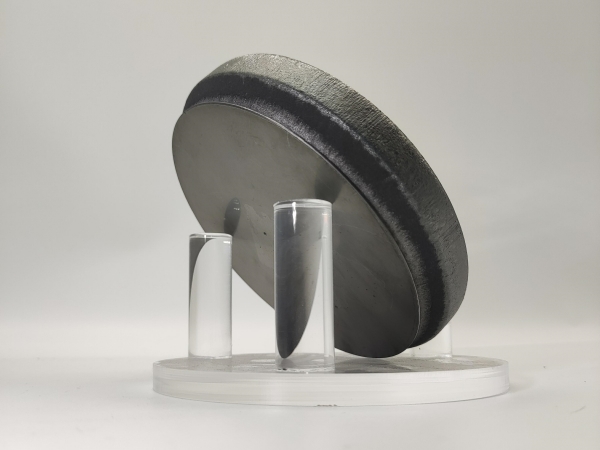
With the rapid development of semiconductor, optics, precision machining, and high-power device industries, the demand for high-performance diamond materials continues to rise. Diamond is regarded as a next-generation strategic material thanks to its exceptional hardness, thermal conductivity, wide bandgap, and chemical stability. However, achieving large-area and high-quality diamond material relies heavily on advanced fabrication technology.
Over the past two decades, breakthroughs in Chemical Vapor Deposition (CVD) have enabled the scalable production of diamond films. Among them, Microwave Plasma Chemical Vapor Deposition (MPCVD) has become the mainstream approach for producing high-quality diamond thick films due to its high controllability, purity, and superior film quality.
In an MPCVD system, microwave energy ionizes gases under low-pressure conditions to form a high-density plasma. Hydrogen (H₂) and methane (CH₄) are dissociated into highly reactive species, which adsorb, diffuse, and bond on the substrate surface to achieve diamond nucleation and epitaxial growth.
This method allows precise control of plasma characteristics, temperature fields, and gas chemistry, enabling superior purity and crystallinity in the resulting diamond films.

Producing large-area, dense, and high-quality diamond thick films requires strict control across several critical process steps. The following five aspects are the most influential parameters in MPCVD growth:
Due to diamond’s extremely low thermal expansion coefficient and high brittleness, substrate materials must provide:
High thermal stability (700–1000°C growth temperature)
Good adhesion to diamond
Reasonable lattice compatibility
Common substrates include:
Silicon (Si)
Molybdenum (Mo)
Tungsten (W)
Tantalum (Ta)
Titanium (Ti)
Nickel (Ni)
These materials support stable nucleation and growth by handling high temperatures and maintaining surface integrity.
The size of the substrate holder influences plasma concentration, density, and shape during deposition:
Larger substrate stages → lower plasma density and reduced growth rate
Non-uniform temperature distribution may affect film uniformity
Optimized stage designs enhance power utilization and improve film quality
Proper engineering of the substrate holder is essential for scaling up to larger deposition areas.
Efficient nucleation is crucial for high-quality film formation.
For heteroepitaxial growth:
Mechanical polishing with diamond powder
Ultrasonic treatment with diamond-powder suspensions
→ increases surface roughness and creates abundant nucleation sites.
For homoepitaxy:
Acid cleaning with H₂SO₄/HNO₃ mixtures
Ultrasonic cleaning in ethanol, acetone, and deionized water
→ removes contaminants and restores surface quality.
Common nucleation enhancement techniques include:
Electrostatic seeding
Bias-enhanced nucleation
Chemical nucleation
Surface-damage nucleation
Multimodal hybrid nucleation
Appropriate nucleation strategies improve initial nucleation density and reduce preparation time.
The CH₄/H₂ ratio has a significant impact on growth rate and film quality:
Increasing CH₄ → increases growth rate
Excess CH₄ → promotes non-diamond carbon phases
Sufficient H₂ → selectively etches graphite, enhancing quality
Optimizing gas flow rates, ratios, and purity is essential for producing high-purity, high-crystallinity diamond films.
Microwave power governs plasma energy density and substrate temperature:
Higher power → higher temperature and plasma density
Increased active species → faster deposition rate
Excessive power → may deteriorate film quality or introduce stress
Importantly, power is not an isolated factor; it couples with chamber pressure, plasma stability, and temperature uniformity, requiring holistic optimization.
MPCVD is currently the most effective method for producing high-quality polycrystalline diamond thick films. Through precise control of substrate material, holder design, pretreatment strategy, gas chemistry, and microwave power, it is possible to achieve highly uniform, low-defect, and stable diamond thick films—supporting next-generation manufacturing and advanced device applications.

JXT Technology is dedicated to the research, development, and supply of high-performance diamond materials. Our product portfolio covers monocrystalline, polycrystalline, and thin-film diamond, widely used in high-power electronic devices, optoelectronics, and advanced integrated circuits—effectively enhancing system performance and reliability. We are committed to providing high-quality diamond materials to global research institutions and high-end manufacturing enterprises.
Sizes: 5×5 mm, 10×10 mm, 20×20 mm
Thickness: 200–1000 μm
Sizes: 10×10 mm, 2 inch, 4 inch, 6 inch
Thickness: 200–1000 μm
Sizes: 2 inch, 4 inch, 6 inch
Thickness: 200–1000 μm
1. Technical OverviewSingle-crystal diamond substrate wafers feature grain-boundary-free...
1. Technical OverviewFeaturing superior comprehensive physical and chemical properties, ...
With the continuous upgrading of high-power continuous-wave lasers, pulsed lasers, and h...