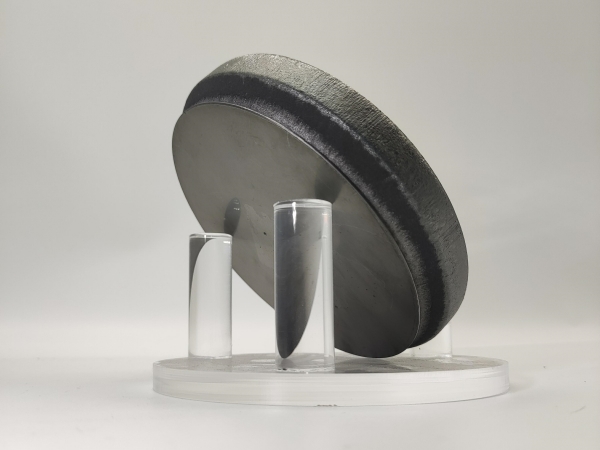
Sapphire (Al₂O₃) has become one of the most important foundational materials in global optoelectronics and compound semiconductor epitaxy. With its exceptional thermal, optical, and chemical stability, sapphire substrates are widely used in LED epitaxy, advanced displays, ultraviolet light sources, and emerging electronic devices—playing an irreplaceable role in these industries.
This article provides a systematic overview of materials that can be epitaxially grown on sapphire substrates, major application areas, and the long-term significance of sapphire in advanced device manufacturing.
1. Unique Advantages of Sapphire Substrates
Sapphire has become the mainstream epitaxial substrate due to its:
High thermal stability — withstands >1100 °C in MOCVD growth
Excellent optical transparency — spanning deep ultraviolet to near-infrared
Strong chemical inertness — resists reactions with epitaxial materials
Hexagonal crystal structure — ideal for GaN, ZnO, and related materials
Lower cost and good scalability — suitable for mass production
Compatibility with
PSS (Patterned Sapphire Substrate) technology, improving epitaxial quality and light extraction
These characteristics have made sapphire the standard substrate for LED and Micro LED industries.
2. Major Material Systems Grown on Sapphire Substrates
2.1 GaN-based Materials (Mainstream and Widely Used)
The largest application of sapphire substrates is the epitaxy of
gallium nitride (GaN) and its alloys:
GaN (Gallium Nitride)InGaN (Indium Gallium Nitride)AlGaN (Aluminum Gallium Nitride)AlN (Aluminum Nitride)These III-N materials cover emission wavelengths from deep ultraviolet (<280 nm) to near-red (~700 nm), forming the basis of LEDs, laser diodes, and Micro LED devices.
Key applications:
High-brightness blue LEDs
White-light illumination
Mini/Micro LED displays
UV LEDs (UVA / UVB / UVC)
GaN-based laser diodes
AR waveguides and light engines
Automotive lighting, projection systems, and backlight units
Although sapphire and GaN have lattice mismatch, techniques such as
low-temperature buffer layers, ELOG, and PSS greatly improve epitaxial crystal quality.
2.2 ZnO-based Materials
Sapphire offers excellent lattice compatibility with ZnO, making it a highly suitable substrate for:
ZnO (Zinc Oxide)MgZnO, CdZnO AlloysTypical applications include:
UV LEDs
Piezoelectric devices (SAW/BAW filters)
Transparent electronics
Sensors
2.3 Emerging or Specialized Epitaxial Systems
Although smaller in scale, sapphire is also used for research or specialty applications in:
Ga₂O₃ (Gallium Oxide)
β-Ga₂O₃ can be grown on sapphire
Useful for ultra-wide-bandgap devices and deep-UV sources
Still in R&D and early commercialization stages
Graphene
Sapphire is commonly used for epitaxial graphene growth, applied in:
RF (radio-frequency) devices
Transparent electrodes
Advanced material research
Magnetic / Magneto-Optic Films (e.g., YIG)
Used in microwave components and magneto-optic isolators.

3. Core Application Fields Enabled by Sapphire Epitaxy
3.1 LEDs and Solid-State Lighting (Largest Global Market)
Sapphire is the standard substrate for blue and white LEDs, supporting a mature and highly scalable ecosystem.
Key benefits:
High-volume manufacturing
Cost-effectiveness
Excellent optical and electrical stability
3.2 Mini/Micro LED Advanced Displays
Mini/Micro LEDs represent next-generation display technology for:
High-end TVs
XR/AR displays
Automotive displays
Transparent displays
Large-format ultra-fine-pitch displays
Sapphire offers multiple advantages for Micro LEDs:
High crystal quality
Low defect density
High brightness and high reliability
Compatibility with PSS and advanced patterning
3.3 UV LEDs and Deep-UV Light Sources
UVA, UVB, and even UVC LEDs rely heavily on AlGaN materials, with sapphire being the dominant substrate.
Advantages include:
High thermal stability
Excellent transparency
Suitable for deep-UV emission
Applications span:
Sterilization and disinfection
UV curing
Medical diagnostics
Environmental sensing
3.4 Laser Diodes (LDs)
Such as:
Blue laser diodes
Green laser diodes
AR/MR light engines
GaN-based LDs on sapphire are widely used in projection, displays, and optical communications.
4. Industry Trends: Sapphire Epitaxy Continues to Evolve
As technologies advance, sapphire-based epitaxy is moving toward:
① Larger wafer sizes (6-inch and above)
Supporting higher throughput and lower cost.
② Advanced patterned technologies (Nano-PSS, Hybrid-PSS)
Enhancing epitaxial crystal quality and light extraction efficiency.
③ Higher uniformity and ultra-low defect requirements
Especially critical for Micro LED applications.
④ Customized epitaxial structures for specialized applications
Such as tailored emission structures for AR light engines.
5. Conclusion: Sapphire Substrates as a Bridge Between Materials Innovation and Industrial Advancement
As a foundational material in optoelectronics, sapphire substrates not only enabled the success of the LED industry, but are also becoming indispensable for Mini/Micro LED displays, UV light sources, AR optical systems, and next-generation devices.
With its stable performance, scalability, and mature manufacturing ecosystem, sapphire will continue to be a crucial material in the development of future optoelectronic technologies.
We are dedicated to providing high-quality sapphire substrates, PSS technologies, and customized epitaxial solutions to support our customers’ next-generation products.
For detailed product specifications, process capabilities, or technical support, please contact us.