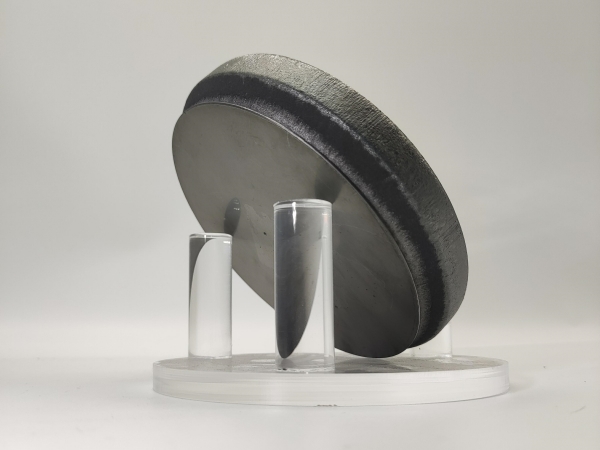
As third-generation semiconductors and advanced display technologies continue to evolve, substrate size has become a key factor in improving manufacturing efficiency and device performance. Following the successful mass production of 2-inch, 4-inch, 6-inch, and 8-inch sapphire substrates, 300 mm (12-inch) large-diameter sapphire substrates are emerging as a focal point in the industry. Their development reflects significant advancements in crystal growth and processing technology and holds promise for high-end power electronics and next-generation optoelectronic applications.
This article provides an overview of the latest progress, technical challenges, and potential applications of 300 mm sapphire substrates.

In semiconductor manufacturing, increasing wafer size offers several advantages:
Higher device output per batch
Reduced cost per device
Improved process uniformity and production efficiency
For sapphire substrates, larger diameters support the development of power devices, oxide semiconductors, and other advanced applications. The 300 mm sapphire substrate represents a key milestone in the evolution of sapphire material technology toward higher-end manufacturing capabilities.
Producing 300 mm sapphire crystals requires extremely precise control over growth conditions and equipment. Recent progress includes:
Stable growth of larger-diameter crystals
Effective management of internal stress to reduce wafer warping
Continued reduction in dislocation density and macroscopic defects
Several research institutions and companies have successfully produced experimental or small-batch 300 mm sapphire wafers, demonstrating substantial advancements in both size and crystal quality.
Compared to smaller wafers, 300 mm sapphire presents higher mechanical stress and warpage challenges during cutting and polishing. Key improvements include:
Optimization of high-rigidity slicing and thinning processes
Application of double-side polishing (DSP) and high-uniformity finishing techniques
Effective control of bow/warp and thickness uniformity
These advances are critical for enabling practical use of large-diameter sapphire substrates in high-precision manufacturing.
Currently, 300 mm sapphire is primarily used for technical verification and advanced research, with potential applications including:
Next-generation power devices and oxide semiconductor substrates
RF and high-temperature electronic devices
High-end research and material validation platforms
In LED and display applications, commercial adoption is still under evaluation due to the complexity and cost of PSS and related processes.
Despite progress, scaling sapphire to 300 mm remains technically challenging:
Crystal quality consistency: Managing stress and defects in large-diameter crystals is significantly more difficult
Processing yield and cost: Equipment and polishing losses are higher, increasing manufacturing costs
Downstream process compatibility: Existing epitaxy and fabrication equipment are optimized for ≤200 mm wafers
Mature supply chain: A fully integrated ecosystem from growth to device application is still under development
The development of 300 mm sapphire substrates reflects the cutting edge of material growth and precision processing technology. In the short term, their main value lies in technology validation, process research, and high-end applications. In the medium to long term, as equipment, processes, and supply chains mature, 300 mm sapphire substrates are expected to find broader applications in high-value semiconductor and optoelectronic devices.
300 mm large-diameter sapphire substrates represent a significant step forward in substrate technology, driven by advancements in crystal growth, processing, and semiconductor manufacturing demands. While challenges remain, the progress made so far demonstrates the industry’s capability to scale sapphire to unprecedented sizes with high quality. As technology continues to advance, 300 mm sapphire substrates are poised to play a key role in next-generation power electronics, optoelectronics, and other high-end applications.
1. Technical OverviewSingle-crystal diamond substrate wafers feature grain-boundary-free...
1. Technical OverviewFeaturing superior comprehensive physical and chemical properties, ...
With the continuous upgrading of high-power continuous-wave lasers, pulsed lasers, and h...