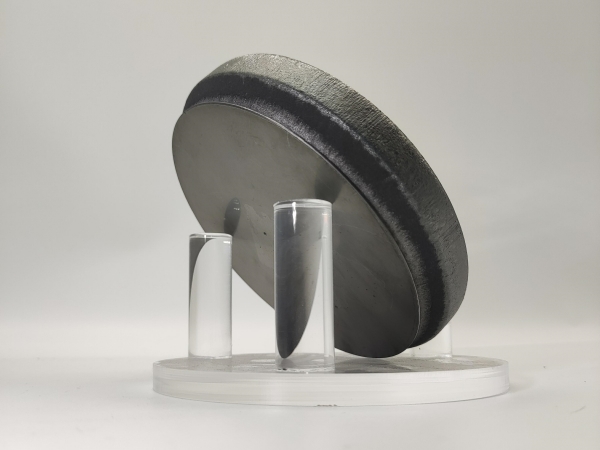
In the fields of solid-state lighting and advanced optoelectronics, Patterned Sapphire Substrates (PSS) have become an essential material technology for enhancing device performance, improving manufacturing efficiency, and enabling next-generation applications. As Mini/Micro LED displays, AR optics, and high-power light sources continue to evolve, the demand for high-quality substrates with engineered optical and structural properties is rapidly increasing. PSS plays a central role in meeting these challenges.
This article provides a comprehensive overview of PSS—its structure, fabrication principles, performance advantages, and future trends.
1. What Is a Patterned Sapphire Substrate?
A Patterned Sapphire Substrate is a sapphire wafer whose surface is engineered with
periodic micro- or nano-scale structures formed through lithography and etching technologies. These structures modify the interface between the
sapphire substrate and subsequent epitaxial layers, as well as influence optical behavior within LED devices.
Common PSS geometries include:
Cone patterns
Pyramid patterns
Cylindrical structures
Hexagonal arrays
Hybrid and custom designs
Typical dimensions include:
Pitch: 100–2000 nm
Height: tens to several hundred nanometers
High uniformity and precise pattern alignmentThese engineered features significantly improve epitaxial growth quality and enhance light extraction, making PSS a preferred substrate in LED manufacturing.
2. How PSS Is Manufactured: Key Process Flow
The fabrication of
PSS requires high-precision patterning and robust etching technology. A standard process flow includes:
(1) Photolithography
Spin-coating photoresist
Exposing periodic patterns using a mask
Developing the photoresist to form a microstructure template
(2) Dry Etching (ICP-RIE)
Inductively coupled plasma reactive ion etching transfers the pattern into the
sapphire substrate, forming conical or cylindrical microstructures.
Critical parameters include:
Etch depth
Sidewall angle
Pattern fidelity and uniformity
(3) Photoresist Removal & Cleaning
The resist is stripped, and the substrate is cleaned to ensure a defect-free patterned surface.
(4) Surface Preparation for Epitaxy
Additional steps such as surface treatment or CMP may be applied before the substrate enters MOCVD epitaxy.
PSS fabrication requires tight process control, high repeatability, and advanced equipment to achieve consistent optical and structural performance.
3. Why PSS Significantly Improves LED Performance
PSS provides two main performance benefits:
(1) Improved GaN Epitaxy Quality
Due to lattice mismatch and thermal expansion differences between sapphire and GaN, dislocations can form in conventional epitaxy.
PSS helps by:
Promoting
Epitaxial Lateral Overgrowth (ELOG)Reducing threading dislocations
Improving crystal uniformity and reducing internal stress
These improvements directly enhance the internal quantum efficiency (IQE) of LED devices.
(2) Enhanced Light Extraction Efficiency (LEE)
In conventional LEDs, much of the generated light is trapped due to total internal reflection.
PSS microstructures:
Scatter light at multiple angles
Create additional escape paths
Reduce light trapping within the device
Depending on the pattern design, LEE improvements of
20–50% or more are commonly achievable.

4. Application Areas of PSS
(1) General Lighting LEDs
PSS has become the industry standard substrate for high-brightness blue LEDs, improving luminous efficacy and reducing cost per lumen.
(2) Mini LED and Micro LED Displays
PSS helps achieve:
Higher brightness
Lower defect density
Improved die uniformity and yield
These factors are critical for fine-pitch displays and AR microdisplays.
(3) UV LEDs (UVA/UVB)
For UV applications, PSS provides:
Better light extraction
Enhanced device lifetime and stability
(4) AR/VR Optical Engines
Mini/Micro LED sources for augmented reality benefit from PSS-induced improvements in brightness and optical control.
5. Future Trends in PSS Technology
As applications advance, PSS is evolving in several directions:
① Micro-Nano Hybrid Patterns
Combining micro-scale and nano-scale features for enhanced scattering and epitaxial control.
② Larger, High-Uniformity PSS Wafers
To support high-volume Mini/Micro LED manufacturing.
③ Customized Pattern Designs
Tailored pitch, shape, and height for specific optical or epitaxial functions.
④ Advanced Lithography Techniques
Such as nanoimprint lithography (NIL) or electron-beam lithography to enable finer features.
6. Conclusion: PSS as a Foundation for Next-Generation Optoelectronics
Patterned Sapphire Substrates are more than a structural base—they are a key enabling technology that improves brightness, efficiency, reliability, and manufacturing scalability. As industries move toward Mini/Micro LED displays, advanced UV sources, and AR optical engines, PSS will continue to play a pivotal role.
Our company is committed to providing high-quality
sapphire substrates and PSS products with superior uniformity, precision patterning, and customizable designs to support diverse optoelectronic applications.
For detailed product specifications or custom PSS solutions, please contact us.