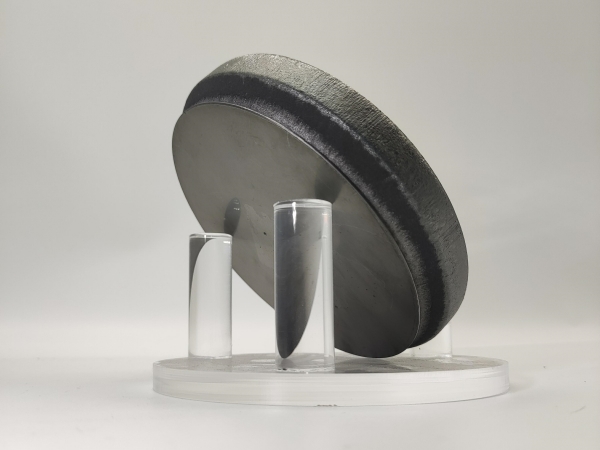
In the fabrication of nitride semiconductor and oxide epitaxial materials, the crystal orientation and cutting method of the substrate play a decisive role in epitaxial quality. Off-axis sapphire substrates are a class of high-performance substrates in which a precisely controlled miscut angle is introduced relative to a primary crystal plane. This design optimizes surface step structures and improves epitaxial growth behavior. Off-axis sapphire substrates are now widely used in LEDs, power devices, and advanced optoelectronic applications.
This article provides a systematic overview of the crystal orientations, miscut directions, and technical advantages of off-axis sapphire substrates.

Off-axis sapphire substrates are intentionally cut at a specific angle relative to standard crystal planes, such as the C-plane, A-plane, R-plane, or M-plane. By precisely controlling both the miscut angle and direction, the atomic step density and step arrangement on the substrate surface can be effectively engineered. This promotes step-flow epitaxial growth and suppresses defects such as twinning and stacking faults.
Typical miscut angles range from 0.5° to 10°, with high angular accuracy of ±0.1°, ensuring excellent wafer-to-wafer consistency for demanding epitaxial processes.
C-plane (0001) sapphire is the most widely used orientation for GaN epitaxy. Introducing a controlled miscut significantly improves surface morphology and crystalline quality of the epitaxial layers.
Surface orientation: C-axis (0001)
Miscut angle: 0.5°–10°, tolerance ±0.1°
Miscut direction: toward the M-axis (1-100)
Surface orientation: C-axis (0001)
Miscut angle: 0.5°–8°, tolerance ±0.1°
Miscut direction: toward the A-axis (11-20)
These substrates are widely applied in high-quality LED and power device epitaxy.
A-plane (11-20) sapphire is commonly used for non-polar or semi-polar epitaxial structures, helping to reduce polarization-related effects.
A–M Orientation
Surface orientation: A-axis (11-20)
Miscut angle: 0.5°–6°, tolerance ±0.1°
Miscut direction: toward the M-axis (1-100)
A–C Orientation
Surface orientation: A-axis (11-20)
Miscut angle: 0.5°–6°, tolerance ±0.1°
Miscut direction: toward the C-axis (0001)
These substrates are suitable for non-polar device structures with stringent requirements on crystal quality and stress control.
R-plane (1-102) sapphire offers unique crystallographic symmetry and is often selected for specialized epitaxial and optical applications.
R–M Orientation
Surface orientation: R-axis (1-102)
Miscut angle: 0.5°–6°, tolerance ±0.1°
Miscut direction: toward the M-axis (1-100)
R–C Orientation
Surface orientation: R-axis (1-102)
Miscut angle: 0.5°–6°, tolerance ±0.1°
Miscut direction: toward the C-axis (0001)
M-plane (1-100) sapphire is an important substrate orientation for non-polar GaN epitaxy.
M–C Orientation
Surface orientation: M-axis (1-100)
Miscut angle: 0.5°–6°, tolerance ±0.1°
Miscut direction: toward the C-axis (0001)
This configuration helps reduce internal electric fields and enhances device efficiency and stability.
By carefully engineering the miscut angle and direction, off-axis sapphire substrates offer several key benefits:
Promotion of stable step-flow epitaxial growth
Reduction of dislocation density and twin defects
Improved surface morphology and epitaxial uniformity
Enhanced device performance and manufacturing yield
As semiconductor and optoelectronic devices continue to evolve toward higher performance and greater reliability, off-axis sapphire substrates have become a critical material solution for achieving high-quality epitaxial growth. Through precise control of crystal orientation, miscut angle, and direction, off-axis sapphire substrates provide a solid foundation for advanced device manufacturing.
Selecting the appropriate off-axis sapphire configuration based on specific application requirements enables an optimal balance between epitaxial quality and device performance.
1. Technical OverviewSingle-crystal diamond substrate wafers feature grain-boundary-free...
1. Technical OverviewFeaturing superior comprehensive physical and chemical properties, ...
With the continuous upgrading of high-power continuous-wave lasers, pulsed lasers, and h...